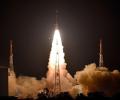
"I am really grateful to the entire ISRO family for having worked this hard and making IRNSS-1I a success," said the space centre's chief K Sivan.

ISRO officials said that the Rs 330 crore mission failed minutes after the rocket lifted off at 4.27 pm. Although they would go ahead with the same mission next year, it is still considered to be a setback since ISRO had planned on using the GSLV rocket for its second moon mission.

Indian Space Research Organisation plans to undertake next month the first developmental flight of a "game-changer" rocket capable of launching four-ton class of satellites from Sriharikota spaceport, says its Chairman A S Kiran Kumar.

Other than the Cartosat-2 series satellite, the PSLV is carrying 29 nano satellites from 14 countries - Austria, Belgium, Chile, Czech Republic, Finland, France, Germany, Italy, Japan, Latvia, Lithuania, Slovakia, the United Kingdom and the United States of America besides a nano satellite from India.
Court questioned the probe agency on delay in filing the chargesheet.

Here's a recap of events that occurred in India in the past 24 hours.

ISRO is focusing on more launches including that of a communication satellite from French Guiana next month.

The rocket is almost 49 meters high -- as much as a 17-floor building. It weighs 415 tons -- as much as the combined weight of 80 full grown elephants.

The countdown began at 6.27 am for the launch on board ISRO's third generation workhorse Polar Satellite Launch Vehicle, in its 47th flight, ISRO said.
It is scheduled for lift-off at 1658 IST on Thursday from the space port at Satish Dhawan Space Centre at Sriharikota, about 100 km from Chennai.

The International Chamber of Commerce's arbitration body International Court of Arbitration has ruled in our favour in the Antrix-Devas arbitration case and Antrix is liable to pay damages totalling $672 million to it, Devas said on Tuesday.
The flight took off from Sriharikota in the Bay of Bengal on schedule.
Israel will hand over the US $18.2 million worth Tauvex II scientific camera for launch abroad its GSAT-4 satellite.

The ISRO had earlier said Chandrayaan-2 will be launched in a window from January-February 16, 2019.Sources said it is expected by the middle of next month but no date has been finalised.
The indigenous rocket will carry the second technology experiment satellite GSAT-2.

An international tribunal has ruled that the Indian government had acted "unfairly" and "inequitably" in annulling a contract between Devas and ISRO's commercial arm Antrix.

The Indian Space Research Organisation has refused to disclose the contents of letters written by its former chief G Madhavan Nair and others in connection with findings by a committee that went into controversial Antrix-Devas deal, saying they were "personal" that may impede process of investigation or apprehension of offenders.
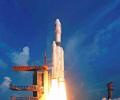
The rocket can put satellites weighing upto four tonnes in space, double the weight that the current GSLV-Mark-II can lift.

The launch will be a major feat in country's space history as no exercise on this scale has been attempted before.

GSLV-MK III, which uses a homegrown cryogenic engine, has to do at least two more launches before it begins commercial operations, report Raghu Krishnan and T E Narasimhan.

ISRO launched 12 Indian, 22 foreign satellites and successfully flight-tested India's first winged-body aerospace vehicle.

The stage is set for the launch of India's satellite IRNSS-1D on Saturday from Sriharikota onboard workhorse PSLV-C27 that would pave the way for the country's own navigation system on par with the GPS of United States.

He said India wanted growth, development and peace in the region and was keen to utilise technology to pursue this goal for the shared prosperity.
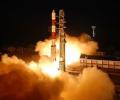
From relying on Russia for its first satellite launch, India is fast becoming a global hub to launch satellites, says T E Narasimhan

Indian Space Research Organisation's plan to soft land Chandrayaan-2's Vikram module on the Lunar surface did not go as per script in the early hours of Saturday, with the lander losing communication with ground stations during its final descent.

Noting that the PSLV was a versatile launch vehicle which can do different jobs and put satellites in different orbits, he said streamlining of this operation with improved capabilities is on.

India has made a good beginning in the area of satellite navigation but still there is a long way to go.

It is important for India to develop multiple launch sites and become capable of undertaking more launches in a year's time, says Ajey Lele.

India is set to operationalise its own navigational system with the successful launch of IRNSS-1D, the fourth in the series of seven navigational satellites, onboard PSLV-C27 from Sriharikota on Saturday.

In a landmark late Monday night journey into a new era of space application, India successfully launched its first dedicated navigation satellite using the Polar Satellite Launch Vehicle which blasted off from the Satish Dhawan Space Centre.
 © 2026 Rediff.com - Advertise with us - Disclaimer - Privacy Policy - Sitemap - Feedback - About us - Terms of use - Grievances